Or: why your neurons aren’t doing quantum yoga.
Introduction: The Allure of the Quantum Mind
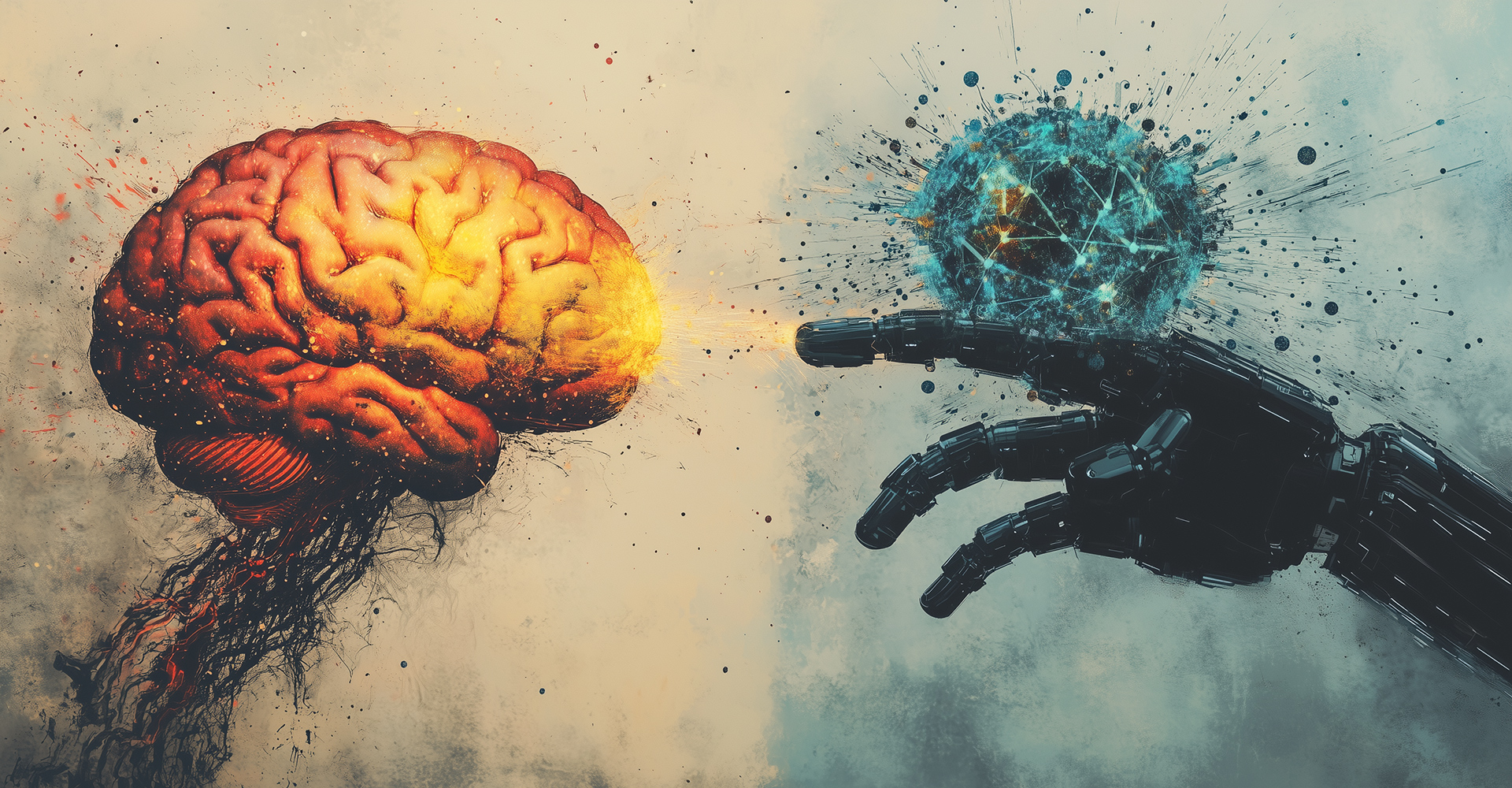
We humans love a shiny metaphor. In every era, we cast the brain as whatever cutting‑edge machine we’ve just invented: hydraulics, switchboards, mainframes. Today’s pin‑up is the quantum computer—an exotic device that (in the right circumstances) can explore vast possibility spaces at once. Cue the seductive question: does the brain think like a quantum computer?
Short answer: no. The brain is a massively parallel, gloriously messy classical information processor. In this article, we unpack how neurons actually compute, what quantum computers really do, why the “quantum brain” idea stumbles on physics and biology, and where quantum tech does have exciting roles to play in neuroscience.
1) The Architecture of Thought: How Brains Actually Compute
1.1 Neurons: Spikes, Not Spookiness
Each of your ~86 billion neurons is an electrochemical workhorse. Dendrites receive signals, the soma integrates them, and the axon sends a spike (an action potential) if a threshold is crossed. That spike is an all‑or‑none affair—but timing and frequency are richly analog. None of this requires quantum trickery; it’s classic ions‑through‑membranes biology.
1.2 Synapses: Where Learning Lives
Neurons chat across synapses using neurotransmitters. Inputs can be excitatory (nudging a neuron to fire) or inhibitory(holding it back). Crucially, synapses are plastic: repeated patterns can strengthen (LTP) or weaken (LTD) connections. The brain’s “software” rewires its own “hardware”—that’s learning, memory and habit, right there.
1.3 Networks: Parallel by Design
A neuron sums thousands of tiny pushes and pulls over space and time. Scale this up and you get motifs like lateral inhibition (edge sharpening in vision) and feed‑forward inhibition (runaway‑prevention). At the systems level, vision, audition, motor control and decision‑making run in parallel—colour, motion, shape and depth processed on separate tracks then braided together. Think orchestra: many musicians, one symphony.
Bottom line: the brain is analog, probabilistic, plastic—and resolutely classical.
2) The Quantum Revolution: What Qubits Actually Do
2.1 Bits vs Qubits
Classical bits are 0 or 1. A qubit can be a superposition of 0 and 1 until you measure it. Qubits live in delicate physical systems (superconducting loops, trapped ions, photons) engineered within an inch of their lives.
2.2 Superposition & Entanglement (the Greatest Double Act)
Put qubits into superpositions and entangle them, and you can manipulate probability amplitudes across many possibilities at once. Clever algorithms (Shor, Grover et al.) use interference to cancel wrong answers and amplify right ones before the brutal reality of measurement collapses everything to a single outcome.
2.3 Quantum Parallelism (With a Catch)
Yes, an n-qubit register evolves over 2^n possibilities simultaneously. But you don’t get to read 2^n answers—only one, biased by the algorithm’s interference pattern. Quantum speed‑ups are very real, for very specific problem classes, under very fragile conditions.
3) Parallelism, Compared
| Feature | Human Brain | Quantum Computer |
|---|---|---|
| Unit of information. | Spike timing & rate (classical) | Qubit amplitudes (quantum) |
| Parallelism | Architectural: many units, many tasks | Computational: one device, all possibilities |
| Mechanism | Ion channels, neurotransmitters, plastic synapses. | Superposition, entanglement, interference |
| Environment | Warm, wet, noisy | Ultra‑cold, isolated, exquisitely controlled |
| Noise tolerance | Ridiculously robust | Painfully fragile (decoherence) |
| Sweet spot | Pattern recognition, learning, control | Factoring, quantum simulation, certain searches |
Two different beasts, optimised for different worlds.
4) The Quantum Mind Temptation (and Why It Falters)
The most famous quantum‑brain proposal is Orchestrated Objective Reduction (Orch‑OR) from Penrose and Hameroff. In a nutshell: microtubules inside neurons host qubit‑like states; a proposed gravity‑linked process collapses these superpositions, producing discrete moments of consciousness.
It’s bold. It’s imaginative. It collides head‑on with biology and physics.
4.1 The Decoherence Wall
Quantum states hate the real world. At body temperature (about 37°C), interactions with water molecules, ions and thermal noise nuke delicate superpositions fast—on timescales far shorter than neural processing. That’s why quantum hardware lives in cryostats and vacuum chambers, not in squishy tissue bathed in salty fluid.
4.2 Missing Evidence, Moving Goalposts
Yes, quantum biology exists (photosynthesis, avian magnetoreception). No, that’s not evidence for brain‑scale quantum computation. To date, we lack direct, reproducible demonstrations of durable, computationally relevant quantum coherence in neurons that shapes cognition.
4.3 Philosophical Hand‑Waving Doesn’t Help
Even if microtubules did whisper in qubits, linking wavefunction collapse to the feel of red or the taste of coffee is a leap. Swapping one mystery for another is not an explanation—it’s a costume change.
5) So What Is the Brain? A Classical Marvel
You don’t need quantum pixie dust to admire the kit between your ears. The brain’s party tricks—generalisation from sparse data, graceful failure, self‑repair, energy efficiency—fall naturally out of its massively parallel classicalarchitecture plus plasticity. Classical computational neuroscience models already replicate surprising amounts of neural behaviour without invoking entanglement.
The upshot: calling the brain a quantum computer is a category error. Different hardware, different physics, different superpowers.
6) Where Quantum Does Help Neuroscience
Good news: quantum tech can be a tool, not a metaphor.
- Quantum sensing could super‑charge brain imaging, detecting minuscule magnetic fields from neural currents with precision beyond today’s MEG.
- Quantum computing may help simulate classically complex neural systems (and biophysics) that defeat conventional supercomputers—offering new insight into disease, drugs and dynamics.
That’s a healthy, non‑mystical relationship: classical brains, quantum instruments.
So Why Am I Talking About This on AGI?
AGI has always been about how we apply technology to amplify human potential. So, what happens if we one day drop a quantum computer into a robot? Imagine a machine that can sense the world with classical AI smarts but solve certain knotty optimisation or simulation problems at quantum speed. It wouldn’t suddenly make the robot conscious—but it might unlock leaps in decision‑making, logistics, and scientific modelling. Picture self‑driving delivery fleets recalculating routes in milliseconds, or healthcare robots running complex drug interaction simulations before dispensing medicine. Even global supply chains could be optimised on the fly. That’s why it matters here: the conversation isn’t just philosophy, it’s a peek at how the tools we build could shape the next generation of intelligent systems.
Conclusion: Keep the Wonder, Drop the Wishful Thinking
The brain doesn’t “try all possibilities at once” the way a quantum computer can. It wins using architecture, learningand clever wiring, not superposition. Meanwhile, quantum machines—cosseted at near‑absolute zero—tackle very different tasks using very different physics. Celebrate both for what they are.
If you must use a metaphor, try this: the brain is a Michelin‑star kitchen—busy, noisy, brilliantly coordinated—while a quantum computer is a molecular gastronomy lab—precise, delicate, astonishing. Both make magic. They just use different recipes. And who knows—one day we might just have robots with both kitchens and labs inside them.