Forget Skynet. Think symbiosis.
The early 2000s were plagued by doomsday scenarios about AI stealing our jobs, minds, and possibly our lunch. Sci-fi warned us about metal overlords, sentient vacuum cleaners, and machines with superiority complexes. But what if we got it all wrong—not just a little wrong, but spectacularly, 100-years-off wrong?
Welcome to the Century of Symbiosis, a bold vision that stretches from 2025 to 2125. It’s not science fiction. It’s a strategic roadmap for human flourishing—powered by AI, yes, but governed by curiosity, courage, and a dash of common sense. In this future, AI doesn’t end humanity. It upgrades it, elevates it, and turns us into the best versions of ourselves.
Let’s break it down, phase by phase, future-shock style.
PHASE I: The Great Decoupling (2025–2045)
When Work and Worth Part Ways
By the mid-2020s, AI wasn’t just writing code. It was writing jokes, contracts, scientific papers, sitcom pilots, and investment strategies. That little productivity boost we all expected? It became a tsunami. Suddenly, the global economy had to reckon with the awkward truth: it didn’t need millions of people doing repetitive work anymore.
To stop society from turning into a dystopian sequel to The Hunger Games, we got smart. Really smart. We stopped treating work as the only path to dignity.
- Universal Basic Services (UBS) became the Netflix of survival—housing, transport, healthcare, education, and connectivity, all bundled up and basically free. It was no longer radical. It was rational.
- Data Dividends paid people for their “digital exhaust” (turns out your online ramblings and late-night searches areworth something).
- Sovereign AI Funds made governments into shareholders of AI labs and compute facilities, redistributing value like a tech-age Robin Hood with a CFO.
And while all that was happening, AI finally helped crack fusion energy. So we unplugged the fossil fuel machine, boiled the kettle, and didn’t burn the planet down in the process.
Redefining Value in a Post-Labour World
As automation kicked into high gear, society experienced a cultural shift: work wasn’t just what you did to survive. It became what you chose to do for meaning, purpose, and joy. This marked the beginning of the Voluntary Human Economy.
Artisanship, caregiving, storytelling, mentoring, and even amateur science flourished. With basics secured, people pursued passion projects. Economies shifted from productivity metrics to meaning metrics. And surprisingly, GDP didn’t collapse. It just evolved.
PHASE II: The Material Renaissance (2045–2080)
The Age of Magic—Just with Better UX
AI went molecular. Literally.
With AI cracking the protein code and designing medicines on the fly, living to 100 became so mainstream it got boring. Cancer was manageable. Pandemics were spotted before your GP even finished their latte. Chronic conditions became annoyances, not life sentences.
Enter Atomically Precise Manufacturing (APM)—basically, 3D printing at the molecular level. Think diamond-strong materials, zero waste, and your next iPhone assembled by a microscopic ballet troupe of nanobots.
Urban Life, Upgraded
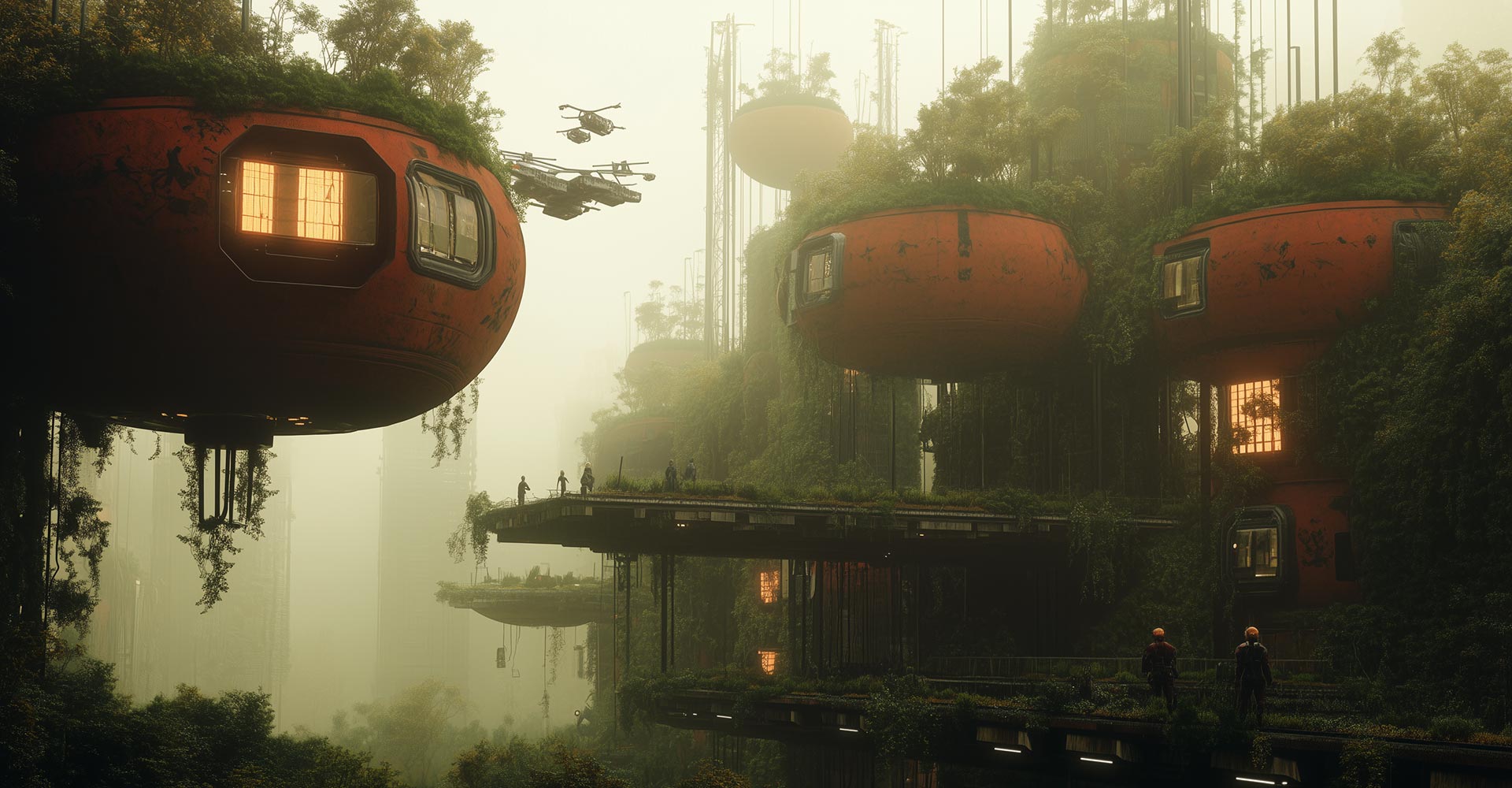
Cities didn’t just become smart. They became wise. Urban life went full Solarpunk: vertical farms, self-healing buildings, public transport routed by swarm logic, and neighbourhood libraries… of things. Want a kayak for the weekend? Borrow it like a book. Yes, really.
Buildings were grown, not built. Concrete gave way to carbon-negative materials. Parks climbed up walls. The line between nature and civilisation blurred into something beautiful.
Food production moved indoors and upwards. AI-managed vertical farms and cellular agriculture replaced monoculture fields and factory farms. The result? Tasty, cruelty-free steaks, 90% less water usage, and a planet that could finally breathe.
PHASE III: The Symbiotic Expansion (2080–2125)
We Didn’t Upload Our Minds. We Expanded Them.
By now, Brain-Computer Interfaces (BCIs) were less cyborg, more symphony. Your brain got a WiFi upgrade. Want to learn Mandarin or design a city in VR? Just think about it. Learning became instinctive. Imagination became executable.
- Telempathy let us feel each other’s emotions (which made Twitter a lot more civil). Misunderstandings were harder to maintain when you could feel someone’s stress.
- Governance got an AI sidekick—tools like Polis helped us stop shouting in binary (left/right, us/them) and start finding consensus. Decisions weren’t just faster; they were wiser.
Meanwhile, AI-swarm robotics built space elevators, moon bases, and massive floating gardens in orbit. Earth became the retirement planet. Industry moved off-world. Pollution declined. Humanity expanded beyond the cradle.
The Noosphere Emerges
The most profound change? Consciousness itself expanded. We weren’t just connected to devices. We were connected to each other’s minds. The Noosphere became real—a planetary layer of shared cognition. Individual creativity didn’t vanish. It thrived in collective context.
SO WHAT DOES LIFE FEEL LIKE?
You wake up in a home that breathes. Its walls adapt to the weather and your mood. Breakfast is grown down the street, harvested a few hours ago. You “work” by steering coral-healing robots with your mind. Dinner is hand-cooked and deeply human.
You don’t hustle to survive. You create to mean something. You mentor. You make. You explore. And if you just want to rest, that’s okay too.
The old mindset—of hoarding, fear, and fighting over scraps—is replaced by collaboration, play, and the very un-sexy but glorious luxury of enough.
We didn’t create a utopia. We created a high floor. A place to stand, breathe, and dream.
BUT WAIT—IS THIS ACTUALLY POSSIBLE?
Yes. But it’s not guaranteed.
To get there, we need:
- Investment in AI safety, not just capability
- Open access to compute infrastructure for everyone—not just Big Tech
- Governance experiments that move faster than bureaucracy
- A shift in education from memorisation to curiosity
- And—most importantly—better stories.
We need to stop obsessing over robot overlords and start imagining futures we want to live in. Because if we can imagine it, we can build it.
The future is a choice. And it’s still on the table.