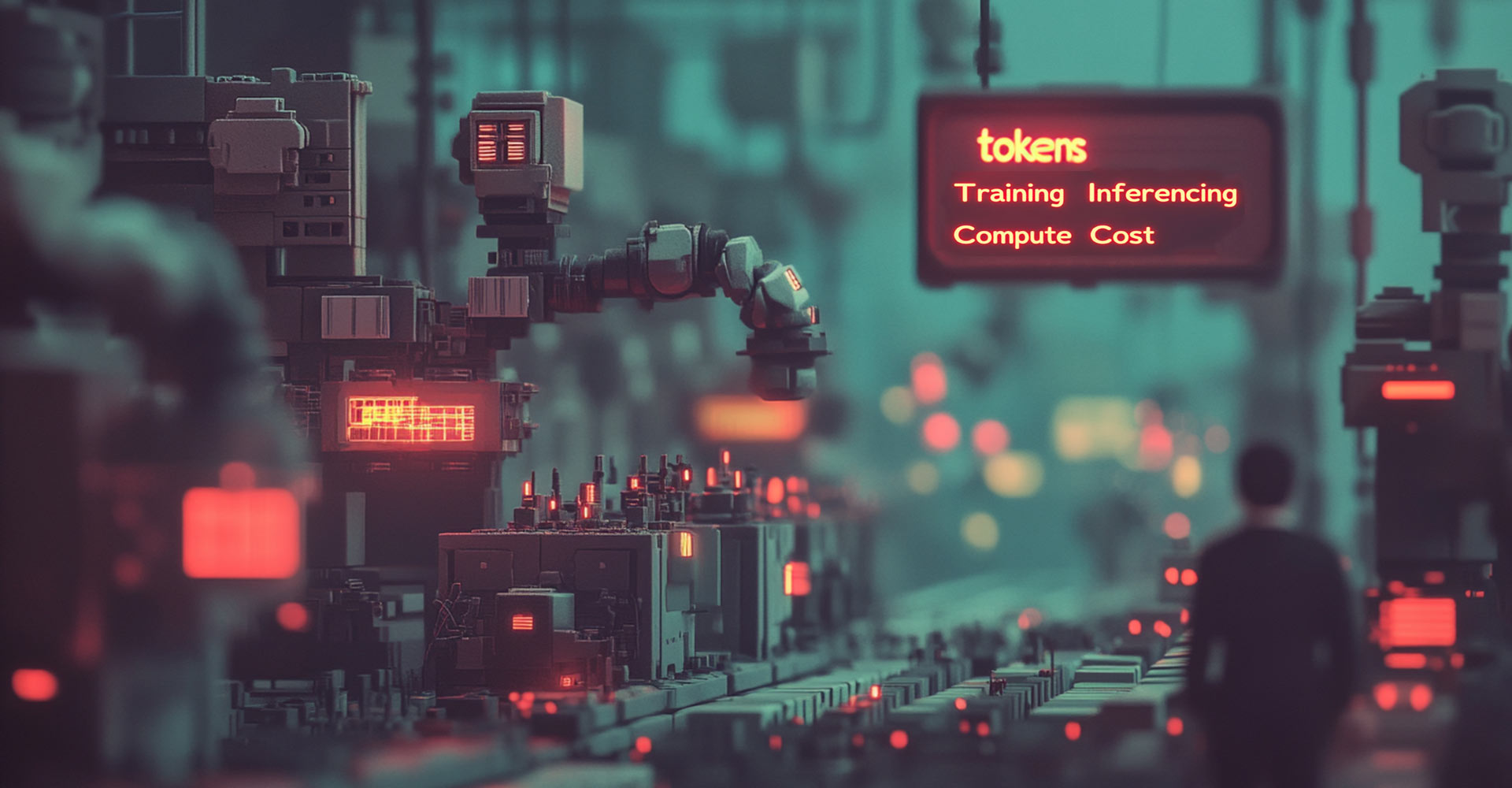
INFERENCE INFLECTION POINT
The Inference Inflection Point marks the transition where AI moves from model training to actively performing complex, resource-intensive tasks in real-world applications.
- Focus shifts from training AI models to executing inference—AI making decisions and taking actions.
- Modern AI agents use extended 'thinking time' for improved reasoning, increasing compute and cost per interaction.
- Data centers evolve into decision factories, optimizing hardware for multi-stage AI workflows.
- Businesses face rising operational costs and must manage AI usage selectively to balance value and expense.
(Or: The Moment “Inference Inflection Point” Made Everyone Go… what?)
Let’s be honest. For years, AI has felt a bit like that clever intern who talks a great game but hasn’t quite been trusted with the big decisions.
That’s changed.
Welcome to what’s now being called the Inference Inflection Point.
First reaction? Probably the same as yours: “Sorry… the what now?”
It sounds like something dreamt up in a lab after too much coffee and not enough sunlight. But behind the slightly over-engineered name is something very real.
And if you run a business, it’s about to affect your costs, your operations, and quite possibly your patience.
From Learning to Doing
Until recently, most of the noise around AI focused on training models. Huge datasets. Eye-watering GPU bills. Clever engineers teaching machines how to think.
That was the warm-up act.
The real shift is happening in inference (the process of reaching a conclusion from evidence and reasoning, in AI terms this means a trained model being put to work to generate outputs, make decisions, or take actions), which is simply when AI actually does something useful. Makes a decision. Solves a problem. Takes action.
Think of it like this:
- Training is teaching someone to drive
- Inference is handing them the keys in central London at rush hour
One is expensive. The other is where things get interesting.
Why This Matters Now
In 2026, AI isn’t just answering questions. It’s behaving more like an employee.
Modern AI agents don’t just respond in milliseconds. They can spend minutes working through a problem, calling tools, checking themselves, and refining their answer before you ever see it.
That’s great for quality.
It’s less great for your electricity bill. Or your finance director’s blood pressure.
We’re seeing up to 10,000x more compute per interaction compared to early chatbots.
That’s not a rounding error. That’s the moment your cloud bill stops being a line item and starts being a personality.
The Rise of “Thinking Time”
Here’s the twist most people miss.
The smartest AI systems today aren’t just bigger. They’re slower on purpose.
They take time to think.
Instead of jumping straight to an answer, they work through steps, test options, and sometimes even argue with themselves before landing on a result. It’s called chain-of-thought reasoning, but in plain English it’s just… thinking properly.
And here’s the kicker. A smaller model that thinks longer can outperform a bigger model that rushes.
So now the game isn’t just about building bigger brains.
It’s about managing how long they think. Which, if you’ve ever sat in a meeting that should have been an email, you’ll know is a skill in itself.
Data Centres Are Now Factories
This shift has quietly turned data centres into something very different.
They’re no longer just places where data lives. They’re factories producing decisions.
Every query is a production line:
- Input goes in
- Tokens get processed
- Reasoning happens
- Output comes out
All powered by some very expensive silicon. The kind that makes your laptop look like it’s powered by a potato.
New architectures are even splitting this process into stages, optimising different hardware for thinking versus answering. Because yes, even AI now has a workflow problem.
From Assistants to Agents
This is where things get properly interesting.
AI is moving from assistant to agent.
An assistant tells you what to do. An agent just does it.
That means planning, adapting, checking results, and sometimes fixing its own mistakes. All of which require more inference, more compute, and more cost.
Businesses aren’t just buying software anymore. They’re buying outcomes.
A logistics agent doesn’t suggest a route. It manages it in real time. A marketing agent doesn’t draft ideas. It tests, optimises, and improves campaigns continuously.
Helpful? Absolutely.
Cheap? Let’s just say this isn’t the era of “unlimited usage” anymore.
The Bit No One Likes Talking About: Cost
Here’s where reality kicks in.
Traditional software had near-zero marginal cost. Add another user and no one noticed.
AI doesn’t work like that.
Every single interaction has a cost. Every decision burns compute. Every “quick question” adds up.
This has given rise to a new discipline: AI FinOps. Which is a polite way of saying, “How do we stop this thing from eating the entire budget?”
Companies are already seeing:
- Runaway usage
- Agents stuck in loops
- Costs spiralling without clear ROI
There’s even a term for it now: inference sprawl.
Which sounds harmless. It isn’t. It’s basically AI going off on a long, expensive wander without getting to the point.
The Smart Response: Be Selective
The winners won’t be the ones using the most AI. They’ll be the ones using it intelligently.
That means:
- Using cheaper, faster models for simple tasks
- Escalating only complex problems to expensive reasoning models
- Designing systems that know when to stop thinking
In other words, a bit of discipline.
Which, historically, hasn’t always been tech’s strongest suit.
The Environmental Elephant in the Room
There’s another issue bubbling under the surface.
All this thinking takes power. A lot of it.
Data centres are becoming some of the biggest consumers of electricity and water on the planet. And while AI is often positioned as part of the solution to climate challenges, it’s also becoming part of the problem.
That tension isn’t going away. And quietly pretending it doesn’t exist won’t help either.
And What About Creativity?
Here’s a slightly uncomfortable truth.
AI is getting brilliant at maths, coding, and structured problem-solving. Give it a clear right or wrong answer and it flies.
Ask it to be genuinely original, and it can still feel a bit… safe.
More thinking time doesn’t always mean more creativity. Sometimes it just means more polished average.
Which, depending on your industry, might be fine.
Or might mean your “AI-generated thought leadership” sounds suspiciously like everyone else’s.
So What Should You Actually Do?
This isn’t a moment for panic. But it is a moment for clarity.
If you’re running a business, the questions have changed:
- What does each AI-driven decision actually cost?
- Where does AI genuinely add value?
- Are we solving real problems or just playing with shiny tools?
The companies that get this right will treat AI like a workforce, not a toy.
Less “look what it can do” and more “is it actually doing anything useful?”
They’ll measure output, manage cost, and design systems that deliver results rather than just impressive demos.
Final Thought
The Inference Inflection Point is the moment AI stopped being clever and started being useful.
But usefulness comes with a price tag.
The next phase of AI won’t be defined by who builds the smartest models. It’ll be defined by who can run them efficiently, responsibly, and without quietly bankrupting themselves.
And that, frankly, is where things get interesting.
Because the clever bit was building AI.
The hard bit is running it without losing your shirt.