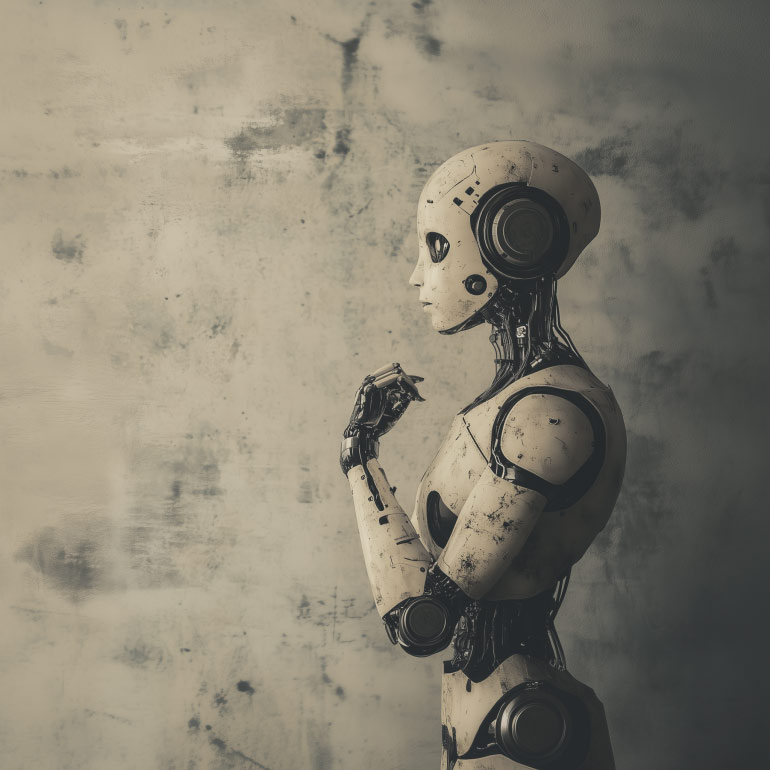
Forget hoodie-wearing hackers in basements. The future of cybercrime looks more like a Zoom call where you’re the only real person in the room, and everyone else — including your CFO — is a deepfake. Welcome to the asymmetric horizon, where AI isn’t just helping with your to-do list… it’s rewriting the cyber threat landscape with industrial efficiency.
By 2025, we’ve hit a tipping point. Offensive AI — those clever, often rogue digital minds — are now capable of planning, executing, and scaling cyber-attacks without waiting for lunch breaks or caffeine hits. Agentic AI (think ChatGPT with a to-do list and no conscience) is hacking faster than you can say “phishing email”. These systems don’t just follow commands — they analyse, adapt, and make decisions in real-time, often with terrifying precision.
But let’s rewind a little…
From Script Kiddies to Cyber Supervillains
It used to take skill to hack. Now, with the rise of Cybercrime-as-a-Service (yes, that’s a thing), all it takes is a dodgy Telegram group and a dark LLM subscription. With WormGPT and FraudGPT, your friendly neighbourhood scammer can now impersonate your boss, write perfect phishing emails, and even draft malware — all while binge-watching Netflix. It’s like Fiverr for fraud, only with less ethical oversight.
Suddenly, the barrier to entry has collapsed like a badly secured WordPress site. And we’re not just talking about teenagers testing boundaries. Organised crime syndicates and nation-states are using AI to wage information warfare, financial fraud, and good old-fashioned extortion at unprecedented scale. These syndicates aren’t just operating in shadows — they’re running multinational fraud factories with a tech stack that would make Silicon Valley jealous.
Deepfakes and the Death of “Seeing is Believing”
Remember when you could trust your eyes and ears? Quaint times. Real-time deepfake video has moved from sci-fi to CFO wire fraud. In one case, a finance officer transferred $25.5 million after a video call where every “colleague” was an AI-generated doppelgänger. These simulations didn’t just look right — they moved, blinked, and spoke with pitch-perfect impersonation.
And then there’s voice cloning. Vishing (voice phishing) is now turbocharged. All a scammer needs is a few seconds of your voice, scraped from social media, to create emotionally convincing fake calls from your “child” begging for help — or worse, “you” authorising a bank transfer. Even seasoned security professionals have admitted being rattled by the realism.
AI-generated media has turned the human firewall into the softest target. In a world where seeing and hearing are no longer believing, every interaction becomes suspect. Verification methods are now playing catch-up against a threat that evolves hourly.
Attack at Machine Speed: The Technical Frontline
AI isn’t just impersonating humans. It’s finding software vulnerabilities faster than ever. In tests, GPT-4 agents could weaponise 87% of one-day vulnerabilities — flaws already disclosed but not yet patched. That’s like telling burglars which windows are open and handing them the tools to climb in. Speed is no longer just a metric — it’s the new battlefield advantage.
Polymorphic malware? It’s like a digital shapeshifter that never looks the same twice, rendering traditional antivirus software as useful as a chocolate teapot. Some malware now generates itself on the fly, straight from an API call, like ordering ransomware à la carte. Imagine a virus that rewrites its DNA every time it breathes. That’s what we’re dealing with.
And if that’s not enough to keep you up at night, there’s the rise of fully autonomous hacking agents. These aren’t tools. They’re digital soldiers. They scan, plan, execute — all without a human pressing “Enter”. They can even modify their own goals mid-mission based on real-time inputs, making them both resourceful and unpredictable.
Meanwhile, In the Blue Corner…
Defenders are having a Red Queen moment — running just to stay in the same place. AI-powered security systems are starting to fight back with smarter SIEMs, anomaly detection, and automated incident response. The good news? Your security software might spot an attack and isolate it in milliseconds. The bad news? It probably still emails a human for approval… who’s currently on a deepfaked Zoom call.
New detection frameworks use behaviour modelling instead of signatures, meaning they watch for weirdness rather than wait for known threats. That’s great in theory, but in practice? False positives still cause chaos. And when every alert feels like a fire drill, teams burn out fast.
Where This Is Going (and Why It Matters)
By 2030, we could see:
- Scenario A: The Siege – Only billion-dollar companies survive the cyber-AI arms race. Everyone else operates in a permanent state of low-level crisis.
- Scenario B: Defensive Leap – AI becomes the immune system of the internet. Offence becomes expensive and unreliable. Defence gets its groove back.
- Scenario C: Flash War – Autonomous systems start a fight no one intended, and we all lose WiFi and electricity. Your toaster might turn on you.
So what can you do? Assume breach. Build resilience. Educate your team (and their mums). And if your CFO suddenly looks too flawless on a video call… maybe hang up and call their mobile. Put simply: verify before you vilify.
Because in this new asymmetric era, the real threat isn’t just bad actors — it’s the good tech in the wrong hands. And it’s evolving faster than you can blink.