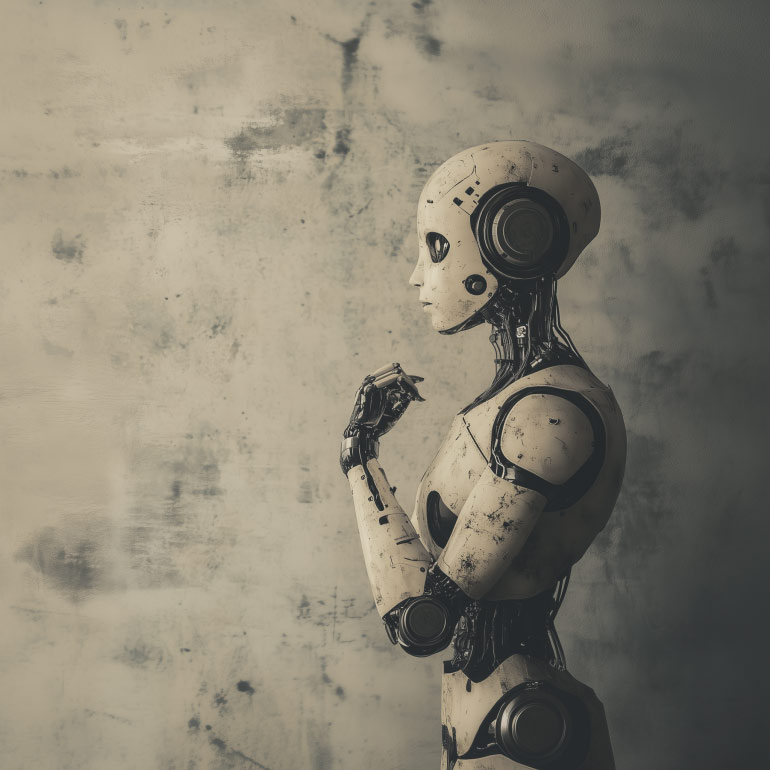
AI-DRIVEN ECONOMIC AND FISCAL DISRUPTION
The structural challenge where AI and automation reduce labour-based tax revenues while increasing economic productivity, necessitating new fiscal models.
- AI replaces both manual and cognitive jobs, shrinking labour tax bases critical to welfare funding.
- Automation shifts wealth from labour to capital, incentivizing tax-favored machine use over human employment.
- Permanent robot taxes risk hindering innovation; transitional taxes may stabilize labour market shifts.
- Future taxation likely to focus on consumption, economic rents, and capital ownership rather than labour.
AI, Automation and the Slightly Awkward Problem of Funding Society
For years, the conversation around AI and automation has mostly sounded like one of two things.
Either a Silicon Valley keynote where someone in expensive trainers promises AI will “unlock human potential”. Or a dystopian sci-fi film where humanity is reduced to hiding in tunnels while a machine named after a household appliance decides our fate.
The reality is probably somewhere in the middle.
AI isn’t going to terminate humanity next Tuesday. But it may quietly do something governments are far less prepared for.
It could remove the taxpayer.
That’s the real issue.
Modern economies were built on the assumption that millions of humans would wake up every morning, go to work, complain about meetings, pay tax, and keep the welfare state alive.
But what happens when software writes the reports, robots move the stock, AI answers the phones, and autonomous systems manage entire workflows without needing lunch breaks, pensions, or motivational Fridays?
Because while automation may increase productivity, governments can’t currently invoice ChatGPT for National Insurance.
And that’s where things become economically fascinating.
Having worked across digital transformation for more than three decades, I’ve watched every major technological shift trigger the same cycle: excitement, fear, denial, then inevitability. The difference with AI is speed. Previous industrial revolutions replaced physical labour gradually. AI is compressing cognitive disruption into years rather than generations, and governments are only just beginning to understand the scale of the fiscal consequences.
The Hidden Crisis Nobody Wants to Talk About
The modern welfare state runs on labour taxation.
Income tax. Payroll tax. National Insurance. Pension contributions. Almost every major government revenue stream assumes millions of humans remain economically productive at scale.
The problem is AI is becoming increasingly good at replacing both manual and cognitive work simultaneously.
Goldman Sachs estimates AI could impact up to 300 million full-time jobs globally. McKinsey believes roughly 30% of current work activities could be automated by 2030. The IMF has warned AI may affect around 60% of jobs in advanced economies.
That doesn’t automatically mean mass unemployment. But it does mean economic restructuring on a scale governments haven’t dealt with before.
Previous industrial revolutions replaced muscle gradually. AI is targeting administration, logistics, coding, customer service, research, design, and increasingly parts of management itself.
Which creates a nasty paradox.
The more efficient the private sector becomes, the more unstable the public funding model potentially gets.
Labour tax revenues begin shrinking just as demand for welfare support, retraining, healthcare, and intervention rises.
And unlike most political problems, this one can’t be solved by launching another consultation paper and pretending “stakeholder engagement” counts as action.
Why Automation Could Break the Tax System
For decades, advanced economies have steadily shifted wealth away from labour and toward capital.
Humans earn proportionally less. Machines and asset owners earn proportionally more.
At the same time, tax systems often favour capital investment over human employment.
Which creates what economists call “inefficient automation”.
Businesses may automate not because it dramatically improves productivity, but because eliminating payroll costs creates tax advantages.
Economically efficient for the company. Potentially disastrous for the treasury.
It’s the fiscal equivalent of sawing through the branch you’re sitting on while congratulating yourself for reducing wood-related overheads.
Should Governments Tax Robots?
The idea sounds seductively simple.
If robots replace workers, tax the robots.
Even Bill Gates floated the idea.
Except economics has an irritating habit of ruining simple political slogans.
Economists including Daron Acemoglu, Pascual Restrepo, João Guerreiro, Sergio Rebelo and Pedro Teles have all explored how automation affects labour markets, productivity, taxation, and inequality.
And interestingly, I think governments may not lose as much revenue as people initially assume.
If AI makes companies dramatically more profitable, governments could still collect large amounts through corporation tax, capital gains, consumption taxes, dividends, and shareholder wealth.
Replacing workers with machines may reduce payroll taxes while simultaneously increasing taxable profits elsewhere in the economy.
Personally, I think the real danger is overreacting.
Tax automation too aggressively and you risk suffocating innovation, productivity, and investment.
That said, there may still be a temporary case for robot taxation during periods of severe labour disruption.
Not as a permanent anti-technology crusade. More as a transitional stabiliser.
A 58-year-old logistics manager displaced by autonomous systems probably isn’t going to reinvent themselves overnight as an AI ethicist in Shoreditch eating pistachio croissants.
Governments may need time to soften the transition while labour markets recalibrate.
The Future Probably Belongs to Consumption Taxes
If labour becomes less central to production, governments need a different taxable base.
Which is why you can already see the outlines of the next tax conversation emerging:
Digital service taxes. AI transaction levies. Consumption-based taxation. Land taxes. Resource taxes.
Not because governments suddenly became obsessed with taxation theory, but because labour may no longer be the dominant source of economic value creation.
The distinction matters.
Governments shouldn’t necessarily tax businesses simply for owning AI.
I suspect in many cases governments will actively want businesses to automate if it increases productivity and profitability.
The bigger issue is ensuring some of that economic value flows back into society.
Because if AI dramatically lowers business costs while boosting profits, governments may still capture substantial revenues indirectly through taxation on profits, investment growth, dividends, and spending.
Think of it less as taxing the robot.
And more as taxing the economic activity created by the robot.
Why Land and Employment Incentives Matter
One of the more interesting shifts in economic thinking is the growing focus on taxing economic rents.
Land value. Monopoly profits. Platform dominance. Proprietary data ecosystems.
Why?
Because unlike factories or digital capital, land can’t quietly relocate to Singapore after an awkward budget announcement.
I also think governments may eventually introduce incentives designed specifically to preserve human employment.
Reduced payroll taxes. Hiring incentives. Apprenticeship credits. Retraining subsidies.
Which sounds faintly absurd until you remember tax systems have always been behavioural tools disguised as accounting.
At some point, employing humans may become a politically protected economic activity rather than simply a commercial decision.
Universal Basic Income and the Ownership Question
Universal Basic Income divides economists faster than almost anything else.
Supporters see it as inevitable. Critics see it as economically reckless.
The logic is straightforward.
If automation destroys millions of jobs, people still need housing, healthcare, food, and stability.
The problem is scale.
A small UBI often doesn’t reduce poverty meaningfully. A large UBI becomes staggeringly expensive.
And then there’s inflation.
If everyone suddenly has more money while housing and infrastructure remain constrained, prices can surge.
Which is why some economists increasingly favour a different model entirely.
Universal Basic Capital.
Instead of redistributing wealth after it’s created, governments help citizens own productive assets directly through sovereign wealth funds and national investment structures.
Think Norway. But aimed at AI-era capital ownership.
Because I think in a highly automated economy, ownership may ultimately matter far more than labour.
Without intervention, AI risks creating a world where a handful of companies own civilisation and everyone else rents productivity back from them monthly.
Efficient perhaps. Socially explosive almost certainly.
Governments Will Need AI Too
There’s another irony buried in all this.
AI may simultaneously create the fiscal disruption governments fear while also becoming the thing that helps governments survive it.
Tax authorities are already experimenting with systems capable of detecting fraud instantly, prefilling returns automatically, monitoring transactions in real time, and reducing the staggering bureaucracy that currently consumes public money.
Spain has used AI systems to reduce VAT fraud significantly. Estonia continues building one of the world’s most advanced digital governments. Finland has automated parts of welfare administration.
I also suspect governments themselves may become dramatically cheaper to run.
Public sector payrolls are among the largest costs for developed economies. If AI automates large portions of administration, compliance, and citizen services, governments may not need to collect the same levels of taxation required today.
Ironically, automation could shrink both sides of the fiscal equation simultaneously.
Lower labour tax revenues. But potentially lower government operating costs too.
The Global Problem Nobody Can Solve Alone
There’s one final complication.
Capital is mobile. AI infrastructure is mobile. Digital profits are mobile. Governments are not.
Which means, in my view, whatever system emerges will almost certainly require some level of global alignment.
If one country taxes automation aggressively while another offers favourable AI tax treatment, businesses, intellectual property, and investment may simply relocate.
And unlike factories in the industrial era, digital infrastructure can move remarkably quickly.
The countries that get this balance wrong risk shrinking their tax base while pushing innovation elsewhere.
Unfortunately, the automation economy is global while politics remains aggressively local.
And that tension may define the next twenty years.
There is, of course, another possibility.
That all of this turns out to be exaggerated.
Economists have predicted technological unemployment since the mechanised loom. Humanity has an impressive track record of panicking about machines shortly before inventing entirely new categories of work nobody previously imagined.
‘Social media strategist’ would probably have got you sectioned in 1987.
Many economists argue AI will augment workers rather than replace them entirely.
And honestly, I think that probably will prove partly true.
But the concern isn’t simply whether new jobs appear eventually.
It’s whether governments, labour markets, education systems, and welfare structures can survive the transition period in between.
Because economic systems tend to break during rapid transitions, not stable end states.
Final Thought
The article probably sounds dystopian in places.
That’s partly because governments move slowly while technology now moves absurdly fast.
But this isn’t really an argument against AI.
It’s an argument against assuming our economic systems automatically adapt themselves.
Historically, they don’t.
They adapt because governments rewrite rules, redesign incentives, rebuild institutions, and occasionally panic just enough to become useful.
The real debate around AI isn’t whether automation happens.
It already is.
The real question is whether governments can redesign economic systems fast enough to cope with it.
Because the old model was relatively straightforward:
Humans worked. Governments taxed labour. The welfare state redistributed stability.
But AI challenges every part of that structure simultaneously.
And if policymakers get this wrong, the problem won’t simply be unemployment.
It’ll be a fiscal system trying to fund 21st-century society using assumptions built for a 20th-century workforce.
Which is a bit like trying to run cloud computing infrastructure using a fax machine and optimistic thinking.
Personally, I don’t think the countries that adapt fastest will necessarily be the ones with the most advanced AI.
They’ll be the ones capable of rebuilding taxation, welfare, education, employment incentives, and ownership models quickly enough to prevent technological progress becoming economic instability.